
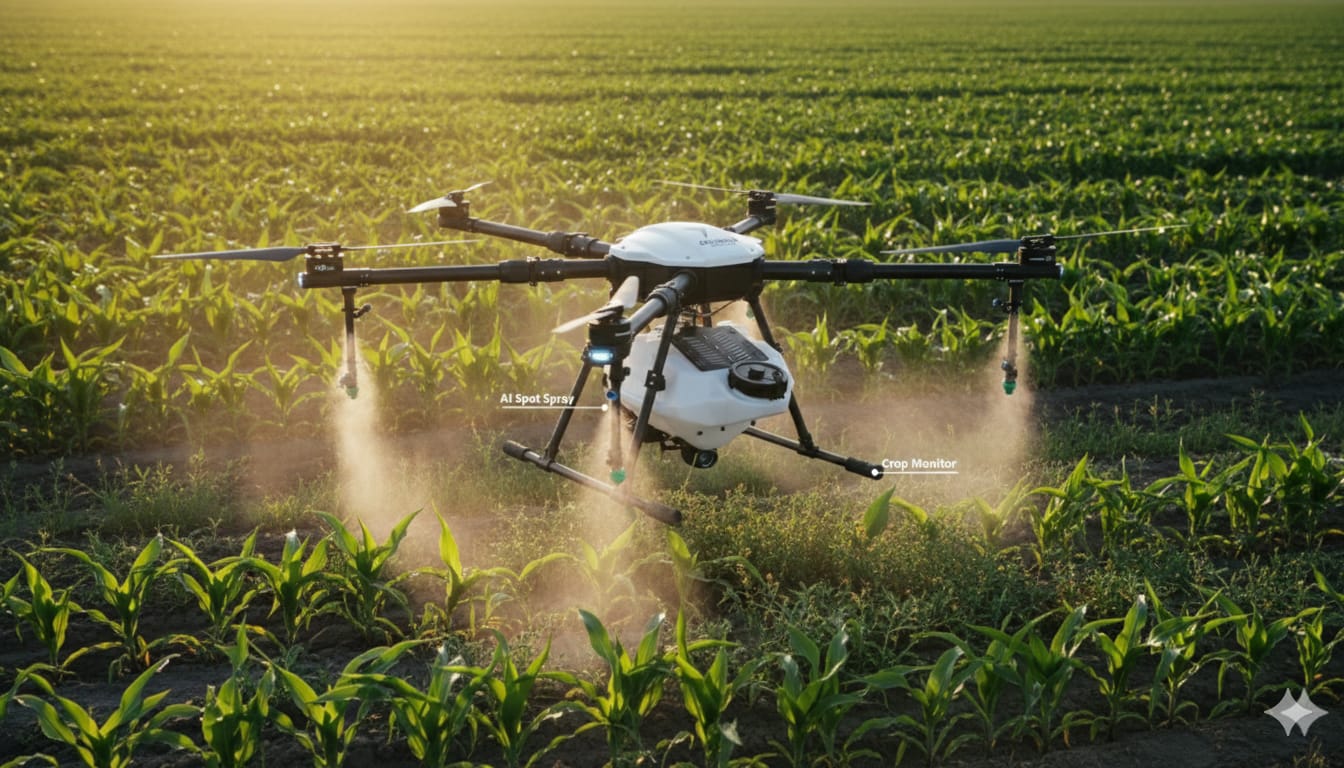
Why AI Drones in Agriculture Are Trending in India
Searches for AI drones in agriculture in India have grown sharply as farmers face rising labour costs, unpredictable weather and more expensive pesticides.
Government schemes, subsidies and startup innovations have made agriculture drones in India more visible, especially for spraying, crop monitoring and precision agriculture use‑cases.
At CruiseHead, the focus is on practical AI agriculture drones that can actually survive dust, heat and small, irregular farm plots instead of just looking good in demo videos.
Ground Reality of Agriculture Drones on Indian Farms
On paper, AI agriculture drones promise perfect spraying patterns, automatic height control and data‑driven decisions, but real Indian fields are uneven, windy and full of obstacles like trees, poles and bunds.
Farmers often struggle with basic issues such as charging batteries in remote areas, getting spare parts, and finding trained pilots who can fly safely across mixed crops and narrow boundaries.
Common Problems with Agriculture Drones in India
- Battery limitations: Many drones can spray only a few acres per charge, and batteries degrade faster in hot conditions, increasing downtime and replacement cost.
- Wind sensitivity: Strong or gusty winds common in open fields can push spray away from the target area, reducing effectiveness and wasting chemicals.
- Over‑spraying and drift: Poorly tuned drones or wrong nozzles can cause over‑spraying, drift onto neighbouring fields and non‑uniform coverage.
- High operating costs: When factoring in batteries, maintenance, pilot fees and transport, some farmers find per‑acre costs higher than expected, especially at low volumes.
These issues do not mean AI drones in agriculture are useless, only that they must be designed and operated for Indian conditions—not for ideal, flat test fields.
Where AI Agriculture Drones Actually Work
AI agriculture drones perform best where the problem is clear and repeatable: uniform crops, medium‑to‑large plots and enough demand to keep the drone busy throughout the season.
They can be especially effective when combined with service providers or FPOs who manage scheduling, pilots and maintenance instead of every farmer trying to own a separate drone.
Spot Spraying and Precision Agriculture
Spot spraying drones, powered by AI cameras or pre‑mapped data, can target only infected patches instead of spraying the entire field, which sharply reduces chemical usage and exposure.
Precision agriculture drones can also map crop stress, waterlogging and nutrient issues, giving farmers a simple visual of where to act instead of guesswork across the whole field.
For many Indian farmers, the most realistic entry point is to use precision agriculture drones through a local service provider rather than immediately buying a high‑end AI spraying drone.
Cost of AI Drones in Agriculture in India
The cost of AI agriculture drones in India varies widely depending on payload, automation level and brand, with basic spraying drones often priced in the several‑lakh rupee range before subsidies.
Beyond the machine, there are three cost components farmers tend to underestimate: training, maintenance and real per‑acre spraying charges.
- Initial cost: Purchasing an AI agriculture drone usually includes the drone, batteries, charger and sometimes a basic training bundle; financing or subsidy support can reduce upfront burden.
- Training & maintenance: Pilots must be trained to fly safely, plan missions and manage batteries, while periodic maintenance, nozzles and repairs add recurring cost.
- Per‑acre spraying cost: Many services price drone spraying per acre, and while it can be competitive with manual spraying at scale, small fragmented plots may see higher per‑acre charges.
Service models, where one drone serves many farmers, often make more sense than individual ownership, especially in villages with small average landholding.
Myths About AI Drones in Farming
A common myth is that AI drones in agriculture will instantly replace all manual labour, but in reality they shift work toward planning, calibration and data interpretation rather than removing humans completely.
Another myth is that any agriculture drone in India is automatically profitable; profitability depends on utilisation, crop type, local prices and support, not just owning a machine.
Marketing videos often show only flat, obstacle‑free land, which hides the fact that drones need careful adaptation for uneven fields, bunds and mixed cropping patterns common across India.
The Future of AI Drones in Indian Agriculture
By 2026, AI drones in agriculture are expected to become more specialised: lighter spot spraying drones, modular payloads and better integration with weather and soil data platforms.
Policy support, standardised training and more reliable after‑sales service will likely matter as much as hardware in deciding which agriculture drones in India succeed long‑term.
At CruiseHead, the goal is to build AI agriculture drones and spraying solutions that are tested on real Indian farms and backed by a team farmers can actually talk to—not just a call centre. You can see the people behind the work on the CruiseHead team page and explore current drone products and layouts.
Have you used agriculture drones on your farm? Share your experience with us through the contact form on the CruiseHead website so future posts can include more farmer‑level insights.