
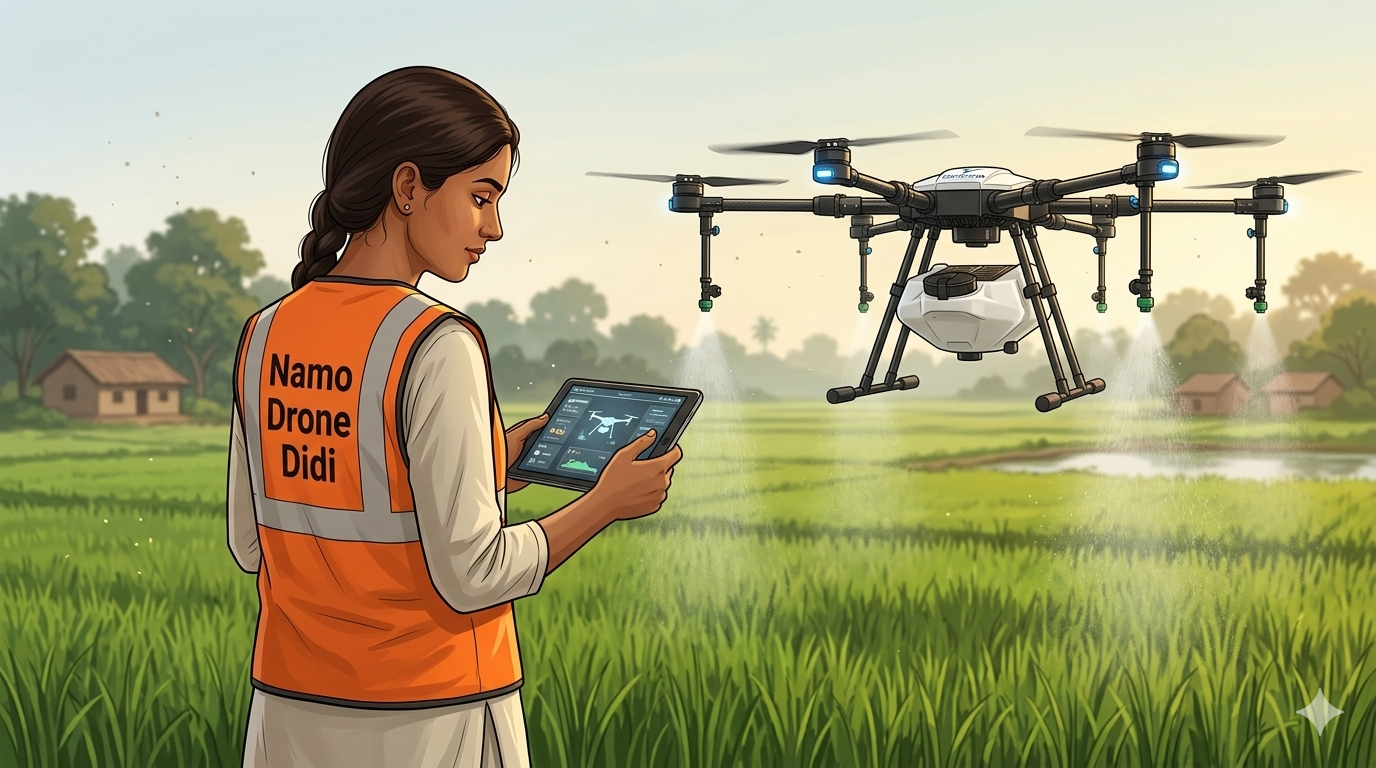
Why Namo Drone Didi and Kisan Drones are trending
Over the last two years, the words “Namo Drone Didi” and “Kisan Drone” have entered village conversations, budget speeches and social media at the same time. Farmers are seeing photos and reels of women operating large agriculture drones for spraying and wondering if this can really work on their own fields.
Government support and schemes have tried to break the biggest barrier in agriculture drone adoption – the high upfront cost of buying a spraying drone, batteries and chargers. Instead of every farmer owning a drone, the push is now towards service‑based models run by self‑help groups, FPOs and rural entrepreneurs who offer per‑acre spraying to nearby farms.
How the model works at village level
In the Namo Drone Didi style model, women’s self‑help groups or co‑operatives receive subsidised drones and training. A small local team is trained to handle flight planning, refilling, battery rotation and basic maintenance, while bookings are taken either directly in the village or through FPOs and agri‑input dealers.
For farmers, this turns an expensive drone into a simple service: they pay a fixed amount per acre for spraying, very similar to how they already hire tractors or harvesters. For the women pilots and SHGs, the drone becomes a micro‑enterprise that can run across seasons, crops and villages within a reasonable radius.
Real advantages farmers actually care about
On ground, farmers are most interested in three things – how fast the drone can finish an acre, whether the spray coverage is uniform and if the final per‑acre cost is competitive with manual labour. When the drone is correctly calibrated and flown by a trained pilot, it can cover an acre in minutes, avoid walking in wet fields and reduce human contact with chemicals.
- Faster coverage during tight spray windows when rains or pests hit suddenly.
- More consistent droplet size and height compared to hurried manual spraying.
- Less chemical exposure for workers who would otherwise carry heavy knapsack sprayers.
These benefits become obvious on larger or clustered fields. On very small, fragmented plots, per‑acre cost and travel time still decide whether drones make sense or not, which is why service providers need to plan their routes and bookings carefully.
The opportunity for women pilots and rural youth
The biggest shift Namo Drone Didi signals is that drone flying and agritech entrepreneurship are no longer “only for engineers in cities”. With the right training, rural women and youth can manage mission planning, safety checks and operations using intuitive ground control apps and standard operating procedures.
For many SHGs, drones become an additional income stream layered on top of existing activities like dairy, tailoring or agri‑produce trading. A well‑run spraying unit can work across multiple crops in a year – wheat, paddy, sugarcane, cotton, vegetables – as long as local regulations and product labels allow drone‑based application.
Hidden challenges nobody shows in social media clips
The reels and photos usually show clean flights and happy fields, but the hard part is keeping the drone running reliably week after week in real Indian dust, heat and rural infrastructure. Batteries degrade, nozzles clog, minor crashes happen and spare parts are not always available quickly in small towns.
Another quiet challenge is building trust. Farmers may hesitate to pay for a technology they have never used, especially if they had bad experiences with low‑quality drones or poorly trained pilots earlier. Service providers have to invest time in doing demo plots, showing before‑and‑after impact and being transparent about chemical quantities, water usage and exact per‑acre rates.
Where companies like CruiseHead fit in
For hardware and service providers, this new wave of schemes is a signal to design more rugged, easy‑to‑repair agriculture drones that fit Indian village reality instead of only focusing on glossy specification sheets. Lightweight frames, reliable pumps, smart battery management and responsive local support matter more than flashy launch events.
At CruiseHead, the focus remains on field‑tested agriculture drones that can survive real conditions – uneven bunds, gusty winds, hot afternoons and long days of continuous spraying. The same philosophy applies whether the drone is flown by a Drone Didi, FPO pilot or a private custom‑hiring entrepreneur.
What this means for the next 3–5 years
If current schemes continue and on‑ground training quality improves, India could see thousands of village‑level drone units serving clusters of farmers instead of a few large companies controlling all spraying. That would make drones feel as normal as tractors and harvesters over time, not a rare “demo day” technology.
For farmers, the smart move is to treat agriculture drones as one more practical tool in their kit – powerful for certain crops, plot sizes and timing, but not a magic answer to every problem. For students and young entrepreneurs, this is the moment to learn drone operations deeply, understand regulations and build trustworthy services around real farmer needs.